How to create uneven pleats?

How to create uneven pleats like in the picture?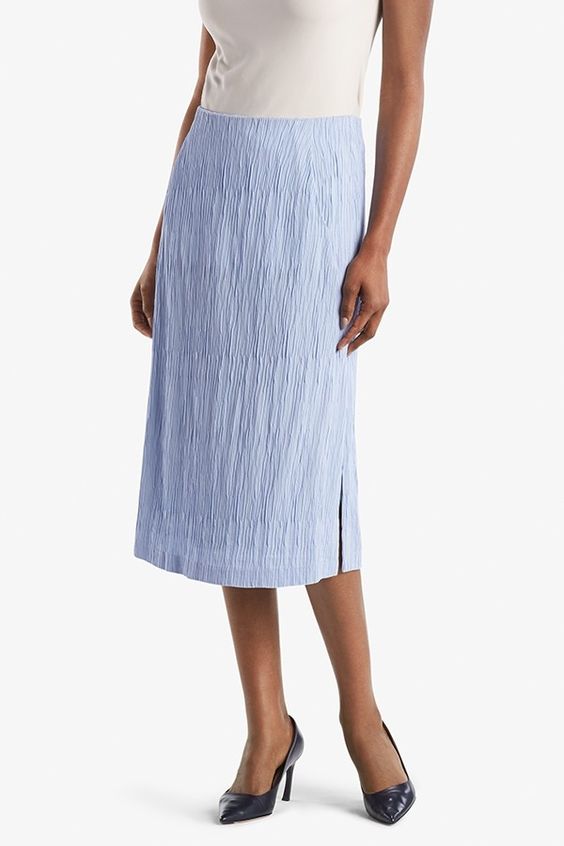
-
Hi esmanur, thanks for your question. For this kind of effect I recommend you to use a Displacement Map. You simply have to create or scan a pleat structure that you like and create a Displacement Map from there. You then can add this Map to your Fabric and scale it diffrently until you achieve the wished effect. You can find some more infromation about the Displacement Map here and here. Have fun exploring this :)
0 -
Esmanur, this has to be treated as displacement with normal maps just like suggested by the CLO Designers team. The reason being you can't get enough geometry to create the pleats and not have a huge and slow-simulation file.
0 -
One way to get micro pleats and the texture maps for those custom details, is to create a square swatch from a piece of fabric at much greater scale (10X) and make it flat on the floor, then micro pleat that into a swatch with fine geometry, then to save this 3D swatch model out of CLO3D and bake the texture maps down to get a finer resolution detail at 1:1 scale that shifts 10X lower than the smallest particle mesh distance possible in CLO3D. eg: 0.3mm
This is actually how I make a lot of my fine detail for photoreal garments with MD/CLO3D, it's simply using CLO3D as a tool to generate more fabric texture maps. This approach does require taking the 3D swatch model into a texture program (eg: the free shader map) and baking a image texture for a depth map and normal map, but that will give you a solid way to squeeze a lot of these finer details into your projects in general.
For all other micro pleating I use tissue paper at reduced scale and crease it into the fabrics required detail by hand, and use stereo photogrammetry (digitization) to get the depth and bump maps using external texture software. This is perhaps the most powerful technique to get all the fine details for garments, as it is controllable, highly accurate and allows for normal blending to any woven and enlarges your texture library. A technique I have been doing for 8 years, and it is perhaps the best approach for all garment detailing. I must have 2,000 + crease maps for fabrics that exclude the weave, so it's possibly the most complete fabric crease library on the planet and it is mind blowingly flexible as a texture tool for fashion detailing so it's a technique that really lifts your garments to the next level. Unfortunately missing in the swag of CLO3D assets, so you need to create this yourself. CLO3D really do need to make a decent crease library separate to a weave textures so bump map blending can be factored in (also missing in their vray shader stack - gulp ) to accompany their pucker maps. Maybe in the next version as this is soorly needed, it's possibly the biggest part of my entire CG effects for photoreal fabrics - and it's missing from CLO3D. And I have had it for 8+ years in my fashion workflow. Yowser, that's a texture oversight. Crucial.
0 -
ottoline Thank you so much! Can I see somewhere your projects?
1 -
No - is the short answer. I have many completed projects on the market, in museums, galleries and in design collections - real stuff that the world finds a use for. Do I need to continually show that - No. Because I do it ... the market consumes it, and then I move on.
_ _ _
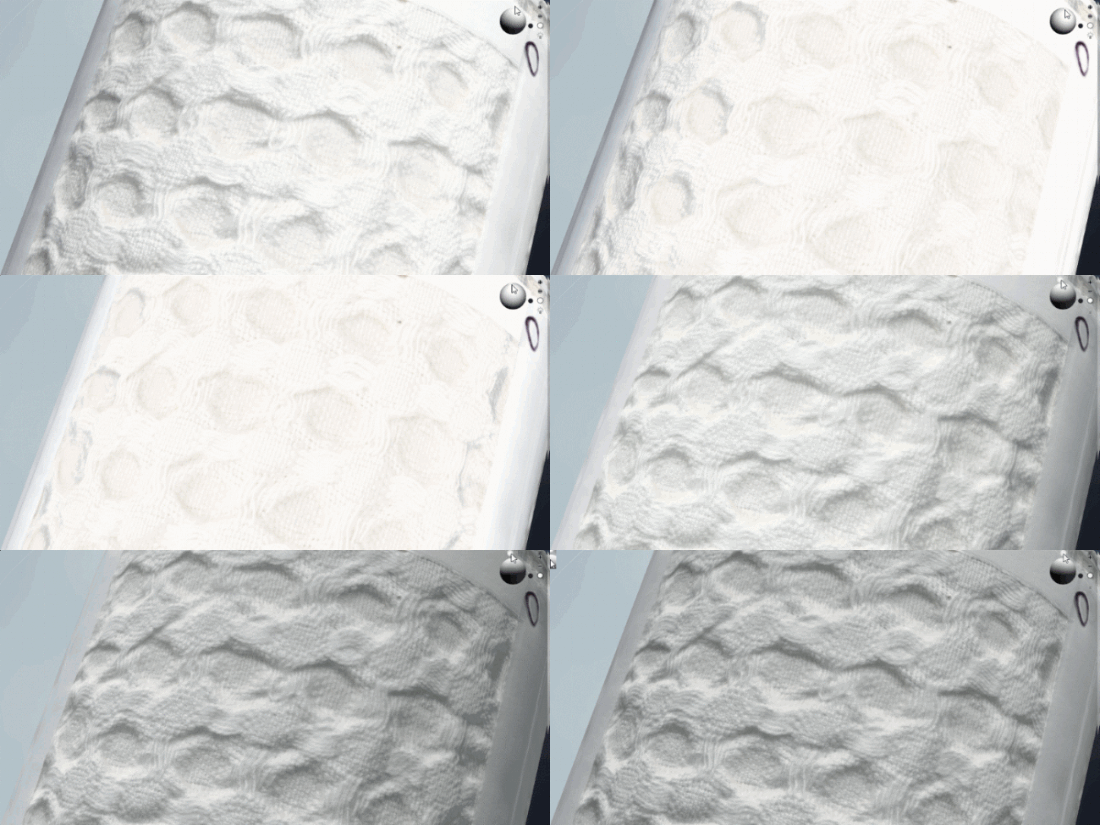
Any texture (micro creasing) can be captured or simulated that is generally down to using your texture simulation software or your digitizing process. Below you can see how the depth (and shadow) for displacement is captured that gives you all the detail when a light is moved over the 3D surface. This is the same for any fabric that exhibits this type of organic creasing at frequencies smaller than the simulation particle distance - you will likely have to decide what approach to use, to best capture your detailing. You can mix frequencies, if the creasing is generic, however for a unique depth map that is specific to a weave (like below) you may need to capture that specifically relative to the sample, or build the node texture setup to mimic that if you don't have a standard crease map in your library for the detail you want in the fabric.
 0
0
댓글