fashion tech, inflatables

Dear All,
I am approaching CLO3D since a little while and I am wondering if the following possibilities are contemplated:
I am trying to test virtually wearable inflatables in CLO3D and did quite interesting experiments cloning layers and using the pressure function but reducing the scale of the object the inflation stop working. Just I would like to know if anyone tried this way already, may be playing with different fabric properties simulating PU membranes or PP airtight sheets.
Please HELP ME!!! :-)
thank you
Ema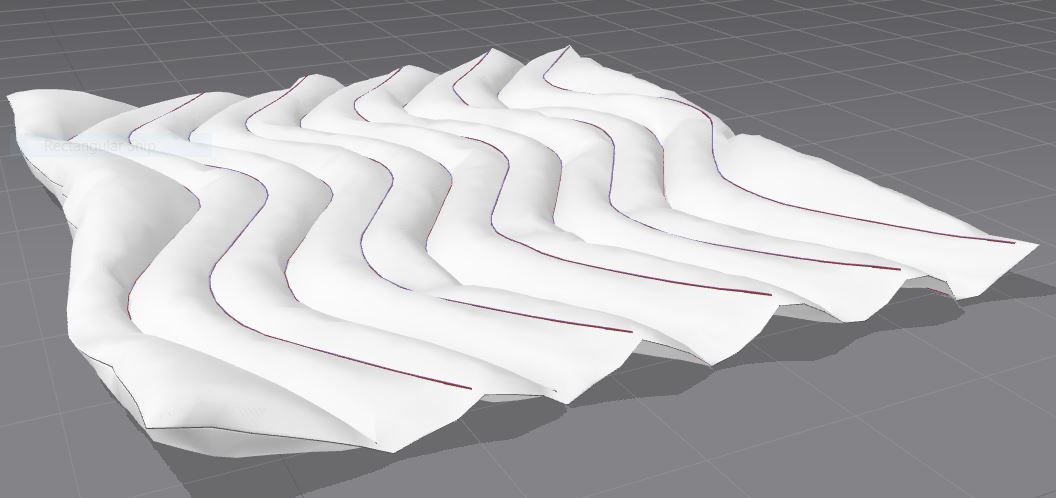
-
Ema, try the Nylon Featherweight fabric. It works really good for puffiness. Also, reduce your particle distance to 5 mm if your pieces are small.
P
1 -
PU is a foam or a cast skin and is made from a mold or extruded (I used to make PU production parts), so no the inflate and cloth tool does not mimic that weight nor it's volume/mass and if using PU sheet it needs to be bonded - so it is very heavy. It would maybe simulate an inflatable PVC type air mattress if you reset the preset to reflect that non-stretch fabric. Where the joints can be heat welded or ultra-soniced to create lightweight structures - also used to do that in the UK for large structures - however CLO3D is maybe limited in that due to it being geared to fabrics.
If you want to simulate PU foam that requires a volume with a totally different mesh structure - you can do that in other software using volume based connected mesh. I know this as I regularly simulate it into production before we cast the molded foam. That is the only >correct < way to do it, otherwise you are simply faking it and it has little to no technical relevance aside from visual image. If you intend to simulate PU /Foam and it's mechanical properties then you need to use the right approach and software tools.
Otherwise you can only simulate an air mattress - in part, as the simulation algorithm has no factor for important things like laminar air flow, used for interfacing surfaces etc.
1 -
thank you both guys! Ottoline this is exacltly what I am looking for, I am laminating fabric with PU membrane and using PU coated polyester USwelded. working on a wearable project I am looking for small scales making integrated tubings and chambers eventually integrated solenoids and pumps. If you could please suggest me the right simulation software for that purpose, even if you could do for me a small evaluation or consultation that would be great.I will keep learning and using CLO3D since I need to develop also the more "conventional" textile part, I tried Comsol but very hard and getting nowhere, someone suggested cangaroo but realized is not a correct physics simulator.
I would be glad if we can continue this conversation either via email or as per your preference.
Thank you
Ema
0 -
I would say unless it's complex to tool (thereby costly or time consuming) simply make a prototype as lamination's typically never quite match the computer simulation anyway, as you get issues like skin shore hardness, glue variance in bonding shears etc, so if it's a simple part often best to simply make it and find out using low cost tooling techniques - probably faster than placing all the data into a computer model to only have it vary. So my thought here is if it's a fashion related product, that means it is likely very low cost to make a tool to find out ... so find out that way. Or make a cross section through the main design to find out. I used to just whip a prototype tool out in a few hours and try stuff out - often the best and most expedient way to get a result that follows production.
I don't have time, other than point you in a direction.
0 -
ok thank you for your suggestions, what do you mean for low cost tooling technique? we are waterjet cutting aluminum plates as a die to insert in the lamination press but it is not supercheap and takes some time. What do you think is the best small inflatable manufacturing technique? US Welding, HF welding, Hot welding, lamination with die?
0
댓글