Shoe last & boot last as avatar setup work flow

Hey guys, starting this thread for ideas on a better cleaner workflow for setting up shoe/boot lasts in Clo
The current technique I use right now is to model the last, then import 1 version as an avatar then a second version that has been uv mapped as garmet. I keep the sole frozen since it comes in as a trace UV map it has the exact shape of the avatar. This way there is no sag when the top pattern is simulated.
Problems I'm having right now is getting the cloth to suck up tighter to avatar(add thick is at 0) and debating is I should import the last at human body size or keep it to the actual real world size. Any suggestions would be great
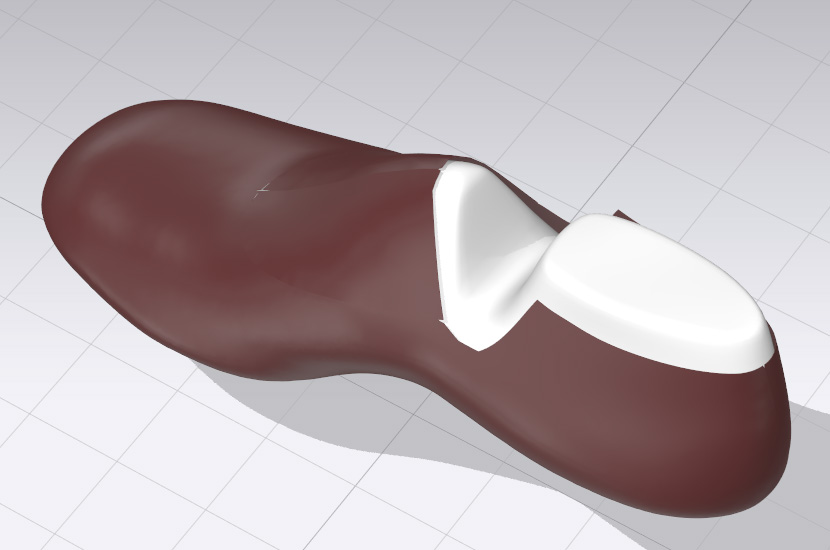
This is just a quick mockup I did to show what I'm talking about.

-
If the shoe is for the avatar, visual, use the base avatar. If the shoe is for realworld use , use a real world last. However you can create a morphable last (shape keys) so that you can stretch any shoe to a new fit and export as thin mesh so it becomes a shoe prop for many avatar characters - cutting down of the work. One size shoe fits many - approach.
A good tool to modify the last's is Blender (mesh fairing tool with line projection ) as you can edit them using the new 2.92 alpha non destructive workflow that keeps the mesh count the same as you tweak the sculpt that allows you to save them into shape keys, making a single shoe last able to be size modified blocks. How you can also turn the CLO3D avatars (feet) into bespoke lasts or morph transforms to put pressure on the shoe leather etc. (stretch the cloth assembly) function on the shoe last. So a custom morphable shoe last for CLO3D base avatars takes a few minutes to edit (and can remain as a shape key) for a range of morphable edits in the base last.
The shoe last (avatar) has an offset collision and so does the leather patterns as well as the fabric (preset). These are acculmalative. If you set each to cancel out each other so the fabrics (preset thickness) is also calibrated to the leathers offset you can get 0.1mm accuracy on the shoes last to leather pattern surface. How I made a real pair of fly-knit (woven) style shoes using MD/CLO3D about 3 years ago. Rather than export double sided surfaces (shoe models) you can stick to thin mesh and apply the same thickness in next workflows using boject modifiers to mimic the additional render thickness in CLO3D. This makes shoe projects non-destructive in mesh editing workflow.
When you create the patterns on the shoes last, you also can add in slash lines on the last where darts should appear and they will help when you unfold the pattern piece. If the shoe last uses a UV algorithm used to relax mesh to most efficient manifold shape you can get better flat patterningby changing the lasts boundary UV flatenning, there is an external tool that is used to calculate better quads and tri-mesh that can improve the base last on compound shapes meaning all flat patterns will exhibit better (more precise weighting interpolation of the last/UV using boundary 1st flattening) unfolding.
0 -
Hey ottonline, just changing the avatar/fabric thickness/additional collision thickness on pattern has really helped. Using lamb skin as a starting fabric seems to get the best results for the toe box section of the pattern.
So I guess for making a knee high boot then, it would be bring in your last scale it over the avatars foot, then make your patter and export out a new shoe, then draft and sim the top section of the boot seperately and pin it to the shoe?
0 -
For a thigh boot, where you have the ankle + knee joint of an avatar, which can be under animated motion the only other way is to rig the boot (with weight maps for the limb joints) and add it too a custom avatar. So basically a custom avatar. If a boot has weight maps and is rigged using the avatar rigging scheme it will load in place. This is how custom characters would be made, but in CLO3D the rigging and bone scheme is bespoke so you would need to work within that rig naming convention framework. OR as you suggest keeping the shoe part of the thigh boot to a simply shoe and then the 'faux' upper part of the boot as a cloth type garter with some tacking to keep it in place.
There is a also the prop tack to avatar tool you can use to place on trim etc but in general you should rig an item that needs to move with the avatar limb motion (eg: thigh boot) as an item.
A good shoe project to do for CLO3D as it introduces a number of technical motion rig hurdles to over come. Notice in the CLO3D shop they always stop the boot's below the knee, which makes there task easy - now you know why, it's maybe hard to do a true thigh boot and make it animate in motion.
Nice project.
0 -
Hey otto, looking at clo's new avatar rigging systems they introduced I want to try an experiment with taking the avatar and resculpting the feet.
1. export avatar to zbrush
2 use zwrap/wrap3 to retopo the avatar with a toesless base mesh
3 project shoe last into the foot and blend the ankle
4. send back to clo and rerig
Then I have avatars setup with a basemesh that has a generic shoe last that I can work off and create different morph targets for. Does that make sense?
0 -
Yes, that makes sense (I use wrap3 for that sort of thing) - let us know how it goes. Good luck.
0 -
This is just a super quick test, but it shows what dropping the avtar skin to 0, fabric to .1 and additional skin thickness to 0 does for anyone who is curious. All the forms and plane changes in the last now show.
 0
0
评论